
#1 pressure washing company in Tallinn
Survepesu Tallinn: Removing Moss from Paving
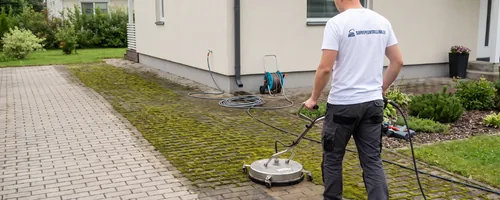
Survepesu Tallinn removes moss from paving stones, concrete slabs and limestone across Tallinn and Harju County. We can do this with paving stone cleaning or as a separate job where the stone itself is clean but its joints have turned green.
Moss grows in the dust and leaf debris that collects in joint sand. High pressure alone blows out the sand; biocide, a low-pressure rinse and fresh joint sand address the growth. By the end of 2025, we had treated 612 paved areas, including 56 in 2025.
- Licensed and insured
- 100% satisfaction guarantee
- 612 moss works by the end of 2025
Get a quote
When paving needs moss treatment
Green joints and grey paving stones
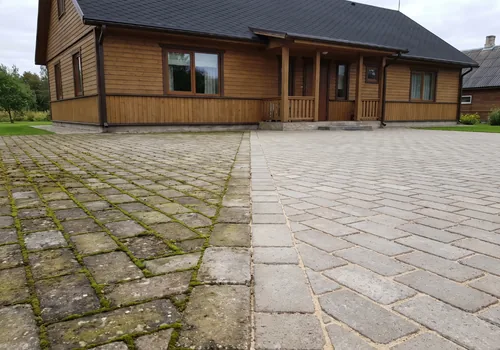
A first sign is a grey stone surface with green joints. If a joint scraper lifts a soft, damp layer and the green line is wider than 5 mm or spreads over the stone edge, moss has taken hold in the joint sand. Sweeping alone will not remove it.
The pavement is slippery when wet
In shade, moss and algae can make wet paving slippery. If a shoe slides easily across a wet stone, the surface may have an algae film that needs biocide treatment, not water alone.
Moss returns after sweeping
If joints turn green again within 6 weeks of brushing or pressure washing, moss remains in the joint. The joint needs treatment and fresh sand rather than another wash at the same pressure.
Why moss grows in paving joints
Moss spores germinate in dust and leaf litter trapped in joint sand. Root-like structures grip between the grains. The stone surface may dry within an hour of rain while the joint stays damp for 3 days.
Shade slows drying, while fallen pine needles and leaves collect in the joints. Washing out joint sand leaves space for more water and spores, so poorly cleaned paving may regrow moss faster than untouched paving.
How we remove moss from paving
Dry preparation and a test patch
Before using water, we scrape and blow loose moss and leaf debris from the joints. Dry debris comes away intact rather than smearing over the stone. On a 1 m² test patch, we apply biocide and rinse from three distances to see when joint sand begins to move.
Biocide and 30 minutes of contact time
We spray a quaternary ammonium-based biocide directly into the joints at low pressure and leave it for 30 minutes. The surface must stay moist during contact time, so we avoid direct midday sun and cover nearby flower beds before spraying.
Rinsing at 30 bar and refilling joints
We rinse loosened moss at 30 bar with a 15-degree fan nozzle from 25 cm away, leaving the sand bed beneath the stones undisturbed. After the joints dry, we refill them with dry sand screened through a 2 mm sieve and compact it with a vibrating plate.
Call us:
- Licensed and insured
- 100% satisfaction guarantee
Driveways beneath pines in Nõmme and Pirita
Pine needles fall into driveways in Nõmme and Pirita throughout the year. Resin holds them to the stones, and moss grows in the damp debris, even in partial shade. We remove moss in October after the heaviest needle fall, blow out the joints before applying biocide and offer a follow-up moss prevention treatment the next spring from €0.90/m². By the end of 2025, we had removed moss from pine-shaded driveways in Nõmme and Pirita 189 times.
Moss removal prices and duration
Moss treatment for clean paving starts at €0.90/m² and covers the joints. Adding a full wash starts at €2.40/m², with joint re-sanding from €1.20/m². Treatment, washing and re-sanding an 80 m² driveway therefore start at €360, plus a €25 Tallinn call-out. Washing and re-sanding takes 4 hours: 2 hours to wash, 1 hour to brush in sand and 1 hour to compact it. Biocide spraying and its 30-minute contact time add to that. The average treated area was 96.4 m²; by the end of 2025, we had treated 58,997 m² of paving.
Moss removal from apartment association paths near Pirita beach
Customer: Priit A., board chair of an 18-apartment association. Work site: near Pirita beach, Pirita. Job number: 10318.
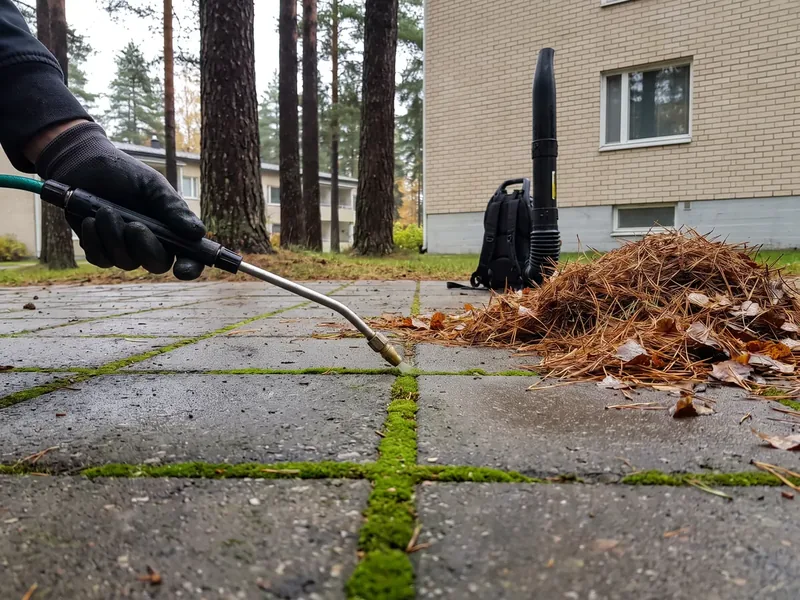
Dry preparation and test patch: In October, after the heaviest pine needle fall, we used a leaf blower to clear joints across 100 m². A 1 m² test patch showed the sand stayed in place at 30 bar. Biocide and 30-minute contact time: We sprayed a quaternary ammonium-based biocide into the joints at low pressure with 6 m/s wind and 4 dry hours forecast, then left it for 30 minutes. Rinsing and re-sanding: We rinsed with a 15-degree fan nozzle from 25 cm away, screened dry sand through a 2 mm sieve, refilled the joints and compacted them with a vibrating plate.
Price: Moss treatment, 100 m² × €0.90 = €90.00; joint re-sanding, 100 m² × €1.20 = €120.00; Tallinn call-out €25.00. Total: €235.00 including VAT.
Duration: 6 hours 20 minutes on one day in October 2025: 30 minutes for dry preparation, 20 minutes to spray, 30 minutes of contact time, 2 hours 30 minutes to rinse, 1 hour 15 minutes to re-sand and 1 hour 15 minutes to compact.
Result: Moss was removed from all 100 m² of joints. The association received a quote for follow-up moss prevention treatment the next spring.
Frequently Asked Questions
Does Biocide Damage Grass or Beds?
We cover flower beds and lawn edges before spraying, then direct the low-pressure spray into the joints to prevent splashes. The biocide acts on moss and algae. Children and pets can use the paving once it has been rinsed and dried.
How soon can moss return after treatment?
Biocide treatment and fresh joint sand can keep open paving clear for years, but shaded, pine-covered paving may need treatment each autumn. Of 612 paved areas treated by the end of 2025, 18 received free follow-up treatment.
Can Moss Be Removed From Limestone Paving?
Yes. Limestone is softer and more porous than concrete, so we allow longer biocide contact time and rinse at no more than 30 bar. Its wider joints may need more sand, priced per square metre.
When is moss removal most effective?
Autumn, after leaves and pine needles have fallen, gives the most lasting result. Spring treatment also works when temperatures stay above freezing and at least 4 rain-free hours follow spraying.
Get in touch
Call +372 XXXX XXXX to ask whether your paving joints need biocide treatment or simply fresh sand.